Friday, May 20, 2022

Goodbye Vangelis

 Vangelis died on May 17th 2022 at the age of 79 years old. This blog is the tribute of his memory.

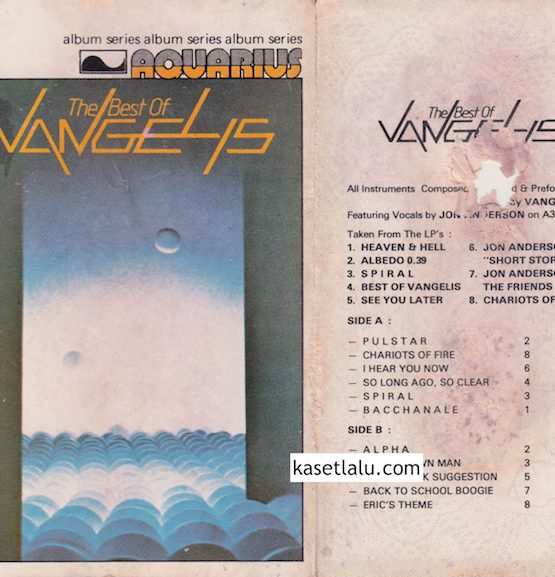
As mentioned many times here I firstly knew his music after hearing Aquarius "The Best Of". I am sure it was released due to Vangelis newest soundtrack album at that time (1981) of a movie titled "Chariot of Fire". I didn't watch the movie but the soundtrack (song no. 2 on the cassette) is a great song. I remember watching a documentary years later that mentioned about Vangelis's break through in soundtrack music. I recall it was mentioned that Vangelis was the first in this genre of soundtrack. 


The first song in this cassette was more interesting. Turned out that for years it was used by Indonesian government television TVRI as the opening soundtrack of the news program called "Dunia Dalam Berita" (World News) which was aired at prime time. Back then TVRI was the sole TV channel in this country and I recall waiting for Dunia Dalam Berita each night. I have no idea if TVRI got permission from Vangelis to use his song for years. 

When that cassette was released "Jon and Vangelis" had issued two albums. From that collaboration, of the two songs in the cassettes I thought "I hear you know" was much nicer song (song no.3 of the cassette). But of course to me the best song of "Jon and Vangelis" is "Deborah", from their third album "Private Collection" which was issued in 1983.

I thought it has great chord progression. Took me years to find the chords. I did not google it but rely solely on my ears. When I got those I posted on my Facebook. Some kind achievement to me.

Good bye Vangelis
Thank you for the music 

References

https://www.bbc.com/news/entertainment-arts-61514850

Thursday, May 19, 2022

electric heat pumps

One of  EU strategies to stop using Russian gas is to speed up the transition from fossil fuel burning boilers to electric heat pumps. I have never heard about is electric heat pump. Below is what I learned about it. 

A electric heat pump is an electrically driven device that extracts heat from a low temperature place (a source), and delivers it to a higher temperature place (a sink). Heat naturally flows from places with higher temperature to locations with lower temperatures (e.g., in the winter, heat from inside the building is lost to the outside). A heat pump uses additional electrical energy to counter the natural flow of heat, and pump the energy available in a colder place to a warmer one.

So how does a heat pump heat or cool your home? As energy is extracted from a source, the temperature of the source is reduced. If the home is used as the source, thermal energy will be removed, cooling this space. This is how a heat pump operates in cooling mode, and is the same principle used by air conditioners and refrigerators. Similarly, as energy is added to a sink, its temperature increases. If the home is used as a sink, thermal energy will be added, heating the space. A heat pump is fully reversible, meaning that it can both heat and cool your home, providing year-round comfort.

Sources: Two sources of thermal energy are most commonly used for heating homes with heat pumps. Air-Source: The heat pump draws heat from the outside air during the heating season and rejects heat outside during the summer cooling season. It may be surprising to know that even when outdoor temperatures are cold, a good deal of energy is still available that can be extracted and delivered to the building. For example, the heat content of air at -18°C equates to 85% of the heat contained at 21°C. This allows the heat pump to provide a good deal of heating, even during colder weather. Ground-Source: A ground-source heat pump uses the earth, ground water, or both as the source of heat in the winter, and as a reservoir to reject heat removed from the home in the summer. Their primary advantage is that they are not subject to extreme temperature fluctuations, using the ground as a constant temperature source, resulting in the most energy efficient type of heat pump system.

Sinks: Two sinks for thermal energy are most commonly used for heating homes with heat pumps. Indoor air is heated by the heat pump. This can be done through: a centrally ducted system or a ductless indoor unit, such as a wall mounted unit. Water inside the building is heated. This water can then be used to serve terminal systems like radiators, a radiant floor, or fan coil units via a hydronic system.

Advantages of Heat Pumps are: lower running costs, less maintenance, reduces Carbon Emissions, long life-span. 
Disadvantages of Heat Pumps are: high upfront cost, difficult to install, requires significant work


References
https://www.bbc.com/news/science-environment-61497315
https://www.nrcan.gc.ca/energy-efficiency/energy-star-canada/about/energy-star-announcements/publications/heating-and-cooling-heat-pump/6817
https://www.greenmatch.co.uk/blog/2014/08/heat-pumps-7-advantages-and-disadvantages

Wednesday, May 18, 2022

transactive memory

Reading "The Bomber Mafia" I caught this interesting term called "transactive memory". I thought I wanted to do some googling about it to understand more about it.

The psychologist Daniel Wegner has this beautiful concept called transactive memory, which is the observation that we don’t just store information in our minds or in specific places. We also store memories and understanding in the minds of the people we love. You don’t need to remember your child’s emotional relationship to her teacher because you know your wife will; you don’t have to remember how to work the remote because you know your daughter will. That’s transactive memory. Little bits of ourselves reside in other people’s minds. Wegner has a heartbreaking riff about what one member of a couple will often say when the other one dies—that some part of him or her died along with the partner. That, Wegner says, is literally true. When your partner dies, everything that you have stored in that person’s brain is gone.

Such specialization reduces the memory load for each individual, yet each individual has access to a larger pool of information collectively. For transactive memory to function effectively, individuals must also have a shared conceptualization of “who knows what” in the group.

Unlike the literal and straightforward ways that computer networks update directories, and locate, store, and retrieve information, transactive memory systems among human agents are often flawed. Transactive memory systems can vary in accuracy (the degree to which group members’ perceptions about other members’ expertise are accurate), sharedness (the degree to which members have a shared representation of who knows what in the group), and validation (the degree to which members accept responsibility for different knowledge areas and participate in the system). 

Transactive memory systems can lead to improved group performance on tasks for which groups must process a large amount of information in a short period of time and on tasks that require expertise from many different knowledge domains. However, there may be situations in which too much specialization may impede group performance, for example, when assigned experts are unavailable, unable, or unwilling to contribute their knowledge. Even when specialization leads to better outcomes, some redundancy may be useful. It helps members to communicate more effectively, it can encourage group members to be more accountable to one another, and it can provide a cushion for transitions in relationships when, for example, the designated expert leaves the group. 


References
http://psychology.iresearchnet.com/social-psychology/interpersonal-relationships/transactive-memory/
https://www.linkedin.com/pulse/transactive-memory-how-trust-your-team-mike-rea/

Tuesday, May 17, 2022

Handling insults

I am wondering how could some people seem do not affected by any insults. I am sure they knew that there are the target of insults and mockery. I am talking about opposition throwing insults to the President. It appears to me that this lowly political strategy does not work at all.  However still I wonder what are the tricks to handle insult. 

In a verbal society, such as the human one, physical aggression is less often used to settle issues of status: These are mostly deferred to verbal interactions. An insult can thus be interpreted as an attempt to reduce the social status of the recipient and raise the relative status of the insulter.

The purpose of a put-down is to reduce someone else in the imaginary status hierarchy. So it is hardly surprising that insults will often refer to a person's social status in terms of ancestry, lack of prestige, or membership in a despised out-group. Otherwise, the content of insults across the ages is monotonously predictable: Many insults feature a sexual component. In addition to status and sexuality, insults inflict shame by mentioning unappealing traits—fatness, shortness, baldness, spottiness, and contagious diseases.

Another way of taking a person down is by questioning their intelligence or general mental competence; for insult purposes, recipients are invariably "stupid" or "crazy."

So, what’s the best way of dealing with insults ?

Acceptance may seem weak but can be the strongest response of all. When someone insults us, we ought to consider three things: whether the insult is true, who it came from, and why. If the insult is true or largely true, the person it came from is reasonable, and his or her motive is worthy, then the insult is not an insult but a statement of fact, and, moreover, one that could be very helpful to us. Hence, we seldom take offence at our parents, teachers, or friends, who, by telling us the truth, are trying to help rather than hinder or harm us. if you think that the person who insulted you is unworthy of your consideration, you have no reason to take offence, just as you have no reason to take offence at a naughty child or a barking dog.

Humor, if successful, can be an especially effective response. Make a mockery of the insult and, by extension, of the insulter. Humor, unfortunately, has some of the same downsides as returning the insult: Your reply has to be funny, and it has to be well-timed and well-delivered

Ignoring the insult is much easier, and, in fact, more powerful. Ignoring the insult works well with strangers but may not be a sensible or viable strategy when it comes to people with whom we have an ongoing personal or professional relationship. 

We need never take offence at an insult. Offence exists not in the insult but in our reaction to it, and our reactions are completely within our control. It is unreasonable to expect a boor (=ill-mannered person) to be anything but a boor; if we take offence at his bad behaviour, we have only ourselves to blame.

Avoid returning insults. It can be tempting to match insult for insult. Ultimately, though, it is best refusing to engage whomever insulted you. "The best way to upset this person is not to insult them in return, but to let them know their words have no impact on me."


References
https://www.psychologytoday.com/us/blog/the-human-beast/201611/the-psychology-insults
https://www.psychologytoday.com/us/blog/hide-and-seek/201302/how-deal-insults-and-put-downs
https://www.wikihow.com/Be-Confident-when-Someone-Insults-You
Monday, May 16, 2022

You never know when it’s going to be your last

Just heard the news via my WA group about one my high school friends who is sick. His wife writes that my old mate could only lay down on his sickbed. I still can recognize him albeit he looks pale, weak and thin. Oh how fragile are we. 

Just last month a colleague of mine passed away. He was almost twenty years my junior. The last time I saw him was the day I left Malaysia. I had no idea that he had a lethal disease. I did not think he knew either. The future is not ours to see.

Recently I read a news that really capture the spirit that you can't take anything for granted in life. Jemas Milner -one my Liverpool heroes-  said “You never know when it’s going to be your last. You go into the dressing room after the game and all of the lads are straight on their phones. I’m saying: ‘You’ve won the FA Cup - get off your phone!". The Reds defeated Chelsea on penalties at Wembley Stadium last Saturday to secure the trophy. Liverpool left-back Kostas Tsimikas scored the decisive spot kick. Come the end of the game, Milner said that he was going to enjoy the victory because it could be the last trophy that he ever wins. “Yeah, you get 40 or 50 messages but you get on the bus and you can deal with that. You are lucky to be a footballer, lucky to play in any final and to win ten medals, if you’ve said that to me at the start of my career then I’d have been pretty happy!

We can see where Milner is coming from. The reality is, the Englishman is 36 years of age. In other words, Milner is at the backend of his career. He is going to enjoy winning a trophy more than others simply because he may never get another chance to lift some silverware.

Indeed, life is short and uncertain. We should enjoy each moment and cherish whatever we have as there would be time that those would no longer possible for us.  

You never know when it’s going to be your last


https://anfieldwatch.co.uk/you-never-know-james-milner-reflects-on-fa-cup-final-victory/


Saturday, May 14, 2022

St. Basil the Great - talking points

St. Basil the Great, Latin Basilius, (born AD 329, Caesarea Mazaca, Cappadocia—died January 1, 379, Caesarea; Western feast day January 2; Eastern feast day January 1), early Church Father who defended the orthodox faith against the Arian heresy. As bishop of Caesarea, he wrote several works on monasticism, theology, and canon law. He was declared a saint soon after his death.

1) Came from family of Bishops
One of Basil’s uncles was a bishop, as later were two of his brothers (Gregory and Peter of Sebaste). 

2) One of Cappadocian Fathers
Basil, together with his brother Gregory of Nyssa and his friend Gregory of Nazianzus, are collectively referred to as the Cappadocian Fathers.

3) Did not consider life as Ascetic 
On returning home he began a secular career, but the influence of his pious sister Macrina, later a nun and abbess, confirmed his earlier inclination to the ascetic life. With a group of friends, he established a monastic settlement on the family estate at Annesi in Pontus. Basil’s health was poor, perhaps because of the rigours of his ascetic life.

4) Famous quote:
The bread you store belongs to the hungry. The clothes you accumulate belong to the naked. The shoes that you have in your closet are for the barefoot. The money you bury deep into the ground to keep it safe, belongs to the poor. You were unfair to as many people as you could have helped and you did not. 

5) Most of the liturgies bearing the name of Basil are not entirely his work in their present form
The extent of Basil’s actual contribution to the magnificent series of eucharistic prayers known as the Liturgy of St. Basil is uncertain. But at least the central prayer of consecration (setting apart the bread and wine) reflects his spirit and was probably in use at Caesarea in his own lifetime. Patristics scholars conclude that the Liturgy of Saint Basil "bears, unmistakably, the personal hand, pen, mind and heart of St. Basil the Great". 

6) Basil is most characteristically revealed in his letters, of which more than 300 are preserved. Many deal with daily activities; others are, in effect, short treatises on theology or ethics. 


References
https://www.britannica.com/biography/Saint-Basil-the-Great
https://en.wikipedia.org/wiki/Basil_of_Caesarea

The Saint Whose Father was a Bishop

St. Gregory of Nazianzus's father also named Gregory, was converted to the Christian faith from the monotheistic sect known as the Hypsistarii under the influence of his Christian wife. He was soon afterward consecrated bishop of his native city, Nazianzus (the exact location of which is not known), by bishops on their way to the Council of Nicaea in 325.

After six years in Athens studying rhetoric, poetry, geometry, and astronomy Saint Gregory returned to his parents at Nazianzus. At thirty-three years of age. against his will, Saint Gregory was ordained to the holy priesthood by his father. 

After the death of the Arian Emperor Valens, Gregory was asked to go to Constantinople to preach there. For thirty years, the city had been controlled by Arians or pagans, and the orthodox did not even have a church there. Gregory went. He converted his own house there into a church and held services in it. There he preached the Five Theological Orations for which he is best known, a series of five sermons on the Trinity and in defense of the deity of Christ. People flocked to hear him preach, and the city was largely won over to the Athanasian (Trinitarian, catholic, orthodox) position by his powers of persuasion. The following year, he was consecrated bishop of Constantinople. He presided at the Council of Constantinple in 381, which confirmed the Athanasian position of the earlier Council of Nicea in 325. Having accomplished what he believed to be his mission at Constantinople, and heartily sick of ecclesiastical politics, Gregory resigned and retired to his home town of Nazianzus, where he died in 389. His last days were spent in solitude and austerity. He wrote religious poetry, some of it autobiographical, of great depth and beauty. He was acclaimed simply as “the Theologian.” 

Gregory's most significant theological contributions arose from his defense of the Nicene doctrine of the Trinity. In contrast to the Arian and Apollonarian heresies common in his day,[45] he emphasized that Jesus did not cease to be God when he became a man, nor did he lose any of his divine attributes when he took on human nature. Conversely, Gregory also asserted that Christ was fully human, including a full human soul.


References
https://www.britannica.com/biography/Saint-Gregory-of-Nazianzus
https://www.oca.org/saints/lives/2022/01/25/100298-saint-gregory-the-theologian-archbishop-of-constantinople
https://www.franciscanmedia.org/saint-of-the-day/saint-gregory-nazianzen
http://justus.anglican.org/resources/bio/155.html
https://www.newworldencyclopedia.org/entry/Gregory_of_Nazianzus