Showing posts with label agama. Show all posts

Friday, September 9, 2022

'Mencari' Tuhan di zaman new normal

Pada sebuah pertemuan kring saya dengar warga membahas plus minus nya misa streaming. Yang plus tentu hal kemudahan. Dari rumah orang bisa ikut misa virtual dari paroki mana saja, jam berapa saja. Disisi minus ada orang yang malas datang misa ke paroki secara fisik. Kalau ada streaming misa mengapa perlu repot datang secara fisik ? Warga kring ini mengatakan orang-orang yang malas datang misa offline sudah menyalah-gunakan fasilitas ini.  

Warga lain menimpali bagaimana ia dimasa pandemi memutuskan menjadi anggota Legio Maria - karena ia sangat merindukan pertemuan offline dan kebetulan Legio Maria seturut aturan organisasi mengharuskan pertemuan secara offline, secara fisik. Bisa dipertimbangkan bahwa gerakan  kerasulan ini didirikan tahun 1921, jauh sebelum era internet.

Warga lain mengenangkan bahwa dari kecil ia diajari bahwa tidak ada alasan untuk tidak datang misa gara-gara orang merasa sedikit pilek atau flu. Ikut  misa justru bisa menyembuhkan sakit ringan macam ini. Di masa pandemi tentu saja sedikit pilek bisa berarti positif covid dan menjadi lebih bijak kalau orang tinggal di rumah dari pada berisiko menulari orang lain. Argumen bahwa ikut misa bisa menyembuhkan bisa dipertanyakan, karena yang bisa terjadi justru ikut misa bisa membuat orang lain sakit, dan bahkan sakit berat.

Warga lain mengingatkan andai kita mengalami pandemi disaat kita tidak punya fasilitas online seperti sekarang. Isoman dizaman lampau bisa menjadi sungguh berat. Sekarang paling tidak orang bisa tetap ikut misa, meski virtual.

Pandemi membuka era 'new normal' yang mengajak orang untuk mengolah iman secara baru. Kalau dimasa lampau 'hadir secara fisik ke misa' adalah bukti bahwa orang sungguh mencari Tuhan - mestinya kriteria itu boleh dipertanyakan dizaman internet ini. 

Kalau persatuan dengan Kristus bisa dialami mana kala kita menyantap roti dan minum anggur secara jasmani Covid membuat kita melihat sisi lain, bahwa persatuan ini bisa pula dialami secara rohani. Pilek sedikit justru membuat orang harus waspada akan kemungkinan menulari orang lain. Maka lebih baik tinggal di rumah. 

Satu hal lagi yang perlu digaris-bawahi bagaimana mencari Tuhan lebih sering dipahami sebagai ibadah. Padahal ada sisi lain yang sama sahnya. Misalnya mencari Tuhan lewat perbuatan, lewat tapa asketis, lewat pertobatan pribadi. Hal-hal yang bisa dilakukan online atau bahkan dalam keheningan isolasi diri. 



Thursday, May 26, 2022

Tablighi Jamaat

Alex Alexiev, vice president for research at the Center for Security Policy in Washington, D.C., is convinced that Tablighi Jamaat would actively involved in future terrorist activities in the US and abroad. Here is my notes on this Tablighi Jamaat movement. . 

Maulana Muhammad Ilyas Kandhalawi (1885-1944) launched Tablighi Jamaat ("Proselytizing Group") in 1927 in Mewat, India, not far from Delhi. Ilyas's followers were intolerant of other Muslims and especially Shi'ites, let alone adherents of other faiths. Indeed, part of Ilyas's impetus for founding Tablighi Jamaat was to counter the inroads being made by Hindu missionaries. They rejected modernity as antithetical to Islam, excluded women, and preached that Islam must subsume all other religions

The Tablighi Jamaat canon is bare-boned. Apart from the Qu'ran, the only literature Tablighis are required to read are the Tablighi Nisab, seven essays penned by a companion of Ilyas in the 1920s. In practice, all Tablighis preach a creed that is hardly distinguishable from the radical Wahhabi ideology. By the late 1960s, Tablighi Jamaat had not only established itself in Western Europe and North America but even claimed adherents in countries like Japan, which has no significant Muslim population. According to Pew Research Centre, Tablighi Jamaat operates roughly in 150 countries around the world. While most Tablighis still live in Muslim-majority countries, such as Pakistan, Bangladesh and Indonesia, the group also has a significant presence in parts of Western Europe, particularly the U.K., France and Spain. Its European membership has been estimated at about 150,000 or more.


The movement's rapid penetration into non-Muslim regions began in the 1970s by large-scale Saudi financing of Tablighi Jamaat. As early as 1978, the World Muslim League subsidized the building of the Tablighi mosque in Dewsbury, England, which has since become the headquarters of Tablighi Jamaat in all of Europe.

The austere and egalitarian lifestyle of Tablighi missionaries and their principled stands against social ills leads many outside observers to assume that the group has a positive influence on society. However, the West's misreading of Tablighi Jamaat actions and motives has serious implications for the war on terrorism. According to Pew Research Centre, the group’s missionary activities and loose organisational structure can be exploited by radical elements. 

References:
https://www.meforum.org/686/tablighi-jamaat-jihads-stealthy-legions 
https://www.business-standard.com/article/current-affairs/the-history-of-the-tablighi-jamaat-and-its-place-in-the-islamic-world-120040300331_1.html
https://www.pewresearch.org/religion/2010/09/15/muslim-networks-and-movements-in-western-europe-tablighi-jamaat/

Wednesday, May 25, 2022

The future of Wahhabism

Following the take-over of the region from the Ottoman Empire, with the help of Western powers, the Saudis needed to come up with a quick and easy method to consolidate power. They turned to Wahhabism to help secure control of their kingdom while silencing dissent. It worked.  

Crown Prince Mohammed bin Salman commented that his country is returning to "moderate Islam, open to the world and all religions". He added that "We won't waste 30 years of our lives dealing with any extremist ideas. We will eradicate extremism". His statement was greeted with boisterous applause by the audience. He made the comments after announcing the investment of $500bn (£381bn) in a new city and business zone. Investors particularly have long been weary of the implications of Wahhabism in Saudi Arabia and its future there.

With an exploding population and massive increase in oil wealth, came many challenges that many Saudi kings have had to deal with. The dominance of Wahhabism in Saudi public life made conducting business in the country very difficult. If Crown Prince Mohammed's plan is successful, Saudi Arabia will be able to return, as he put it, "to moderate Islam." This will allow it to get along with its other Muslim neighbors. The export of Wahhabism has also been very costly for Saudi Arabia and has caused sectarian divisions among Muslims internationally. 

On January 27, 2022 King Salman bin Abdulaziz issued a royal decree designating February 22 as a national holiday called the “Founding Day.” This day commemorates “the beginning of the reign of Imam Mohammed ibn Saud and his foundation of the first Saudi state,” The event has substantial political significance as it signifies a radical break with the Wahhabi political influence that had legitimized the Saudi political projects since 1744. electing 1727 instead of 1744 as the country’s founding year does not only signify a break with the Wahhabi political myth.

The Wahhabi political myth refers to the narrative that the first Saudi state was born out of a covenant made between Muhammed ibn Abdul-Wahhab and Mohammed ibn Saud in 1744. This political myth legitimizes the Saudi state by presenting it as an indispensable tool to apply, spread, and protect Wahhabi Islam. Although theoretically it puts the Saudi project in a subservient position in relation to the Wahhabi mission, it gives the state a divine mandate, while it also frees it from the historical responsibilities resulting from the agreements that the Saudi leadership made with different local elites during the state-formation period in the early 20th century.

By selecting the beginning of the reign of Mohammed ibn Saud as the state’s foundational moment, it creates a new myth that leaves no room for Muhammed ibn Abdul-Wahhab and his movement. What is different now is the deliberate departure from this foundational narrative. The official erasure of Wahabism is an ongoing process and it is not restricted to national holidays and official narratives. The new history textbooks do not mention Muhammad ibn Abdul-Wahhab. 

Prospective changes that further dampen the crown’s ties to fundamentalist Islam could prompt pushback, either by other members of the royal family or by religious leaders, or by a combination of both. Other royals are resentful that they have been marginalized, and the once well-funded clerical establishment has been steadily undermined by Mohammed bin Salman’s tactics. Additionally, some may sense this is the last chance to stop Mohammed bin Salman from becoming king. Measures by the royal court to block such opposition can also be expected.


References:
https://www.dailysabah.com/columns/taha-meli-arvas/2017/10/26/what-death-of-wahhabism-means-for-mid-east-economy
https://www.bbc.com/news/world-middle-east-41747476
https://agsiw.org/the-saudi-founding-day-and-the-death-of-wahhabism/
https://www.washingtoninstitute.org/policy-analysis/saudi-arabia-adjusts-its-history-diminishing-role-wahhabism

Tuesday, May 24, 2022

the Wahhābī

In 1740 Muḥammad ibn ʿAbd al-Wahhāb began promulgating his teachings which became known as Wahhābī. The Wahhābī stress literal interpretation of the Qurʾān and Sunnah and the establishment of an Islamic society based only on these two bodies of literature. The political fortunes of the Wahhābī movement were closely allied to those of the Saudi dynasty since Muhammad ibn Saud in 18th century.  The activities of Ibn Saud in the 20th century eventually led to the creation of the Kingdom of Saudi Arabia in 1932 and assured Wahhābī religious and political dominance on the Arabian Peninsula. The preeminence of the Wahhābī religious establishment has ensured that the Kingdom of Saudi Arabia remains markedly more conservative than other states in the region. A large religious police force (known as the Muṭawwaʿūn) enforces strict codes of public behaviour—including, for example, mandatory observance of Islamic rituals and gender segregation.


Strict Wahhabis believe that all those who don't practice their form of Islam are heathens and enemies. Critics say that Wahhabism's rigidity has led it to misinterpret and distort Islam, pointing to extremists such as Osama bin Laden and the Taliban. Wahhabism's explosive growth began in the 1970s when Saudi charities started funding Wahhabi schools (madrassas) and mosques from Islamabad to Culver City, California. Some analyst claimed that over the last 30 years is that some 85 to 90 billion dollars have been spent fostering and spreading Wahhabism in the world. He continued that even though not all young men who go to Wahhabi schools and madrasses in Pakistan become disciples of Osama bin Laden or terrorists. But that is the soil in which Islamist terrorism is growing.

References
https://www.britannica.com/topic/Wahhabi
https://www.pbs.org/wgbh/pages/frontline/shows/saudi/analyses/wahhabism.html
https://www.pewresearch.org/religion/2005/05/03/the-global-spread-of-wahhabi-islam-how-great-a-threat/

Monday, May 23, 2022

Historical background of Sufism

 I am interested to understand the historical of Sufism so here is my summary

The close contact between the Muslim and the Christian communities during the formative years of Islam had its influence on the development of the Sufism – the mystic traditions of Islam. Sufism established itself within the traditions of the Islam.  The Sufis believe that communion with God is possible through Muhammad, who was the recipient of the knowledge of the heart (Ilm-e-Sina) besides the outer knowledge (Ilm-e-safina). Ali, one of the Muhammad's companions and son-in-law, is considered to be the first Sufi to whom the Ilm-e-Sina was revealed by Muhammad to be taught to those capable of understanding it. The concept of God, the possibility of esoteric knowledge and the ways to access God through purification of self by means of prayer, fasting and repentance that form the foundations of Sufism find their source in the Quran and the teachings of the prophet known as Hadith.

Sufism in the beginning was primarily an individual endeavor. The Sufis would usually live in isolation practicing self-mortification and were distinguished by a cloak of wool (Suf), a tradition of Muhammad, which is believed to be the origin of the word Sufi.

But even though Sufis wore suf, wool, from the very beginning of Islam, the word “Sufism”, according to Arab grammar, is not a derivative of the word suf, and not whoever wears suf is a Sufi. Or as Sheikh Saadi, a great Persian poet and sage said: The goal of the people of the inner path is not their outer garments. Serve the King yet remain a Sufi. 

Other scholars believe that the word “Sufi” derives from the word “sufateh”, the name of a thin plant. Sufis were usually thin because of extreme mortification and fasting. Thus they were likened to sufateh as symbol for their emaciation. But, as in the preceding theory, this assumption is not linguistically or grammatically correct.

Another group of scholars claim that the word “Sufism” is a derivative from the Greek word “Soph”, meaning wisdom or knowledge. But this assumption does not seem right either. Aside from the different spellings, Sufis, and especially the Sufis of the first few centuries, denied that philosophy could be a fitting tool for understanding reality, since through its reliance on verbal descriptions and limited reasoning philosophy would actually obscure rather than reveal the truth or reality.

There is also yet another idea regarding the word Sufism. It seems that before the time of the Prophet Mohammed there was a group of very pious people who worked as the servants of the Kaaba. These people were called “Sufe”. Their practices included mortification and the avoidance of any physical pleasures. Some assume that the word “Sufism” is a derivative from the word “Sufe”, but this assumption does not bear close examination, as the rules of Arabic grammar as well as the different styles of the practice make its fallacy evident. Etymologically, “Sufi” is not a derivative of the word Sufe; historically Sufis were a group of Moslem intellectuals forming a School of an inner path based on the instructions of the Prophet Mohammed and the teachings of the Koran. Necessarily, this school had to be established after the advent of Islam and not before.

A group of such devouts lived a life of poverty and incessant prayer and fasting on a stone bench in front of Muhammad's mosque. These people of the bench (Ashab-e-suffa), 45 to over 300 in number, were given to much weeping and repentance and are believed to be the origin of the Sufism. However, the name Sufi was given to such ascetics only around the second century of death of Muhammad. The Sufis in the early period were primarily ascetics and Sufism had not yet evolved into a fully developed system of theosophical doctrines, which became the core feature of the later Sufism.

The companions of Muhammad like Bilal, Salman Farsi, Ammar bin Yasir were the early mystics. Later with the spread of Islam Sufism flourished in Iraq, Syria, Egypt, Persia and Central Asia and gave birth to the renown Sufis like Rabia Basri, Hasan Basri, Junayd Baghdadi, Dhun Nun Misri, etc., around the 9th and 10th century.

As the early Sufi masters started teaching those in search of divine, a distinct tradition in the form of closely-knit communities centered around these masters flourished. The transformation of such communities into those, which shared a spiritual lineage, took place around the 11th century and led to the formation of Sufi orders (silsilas), chains through which they would eventually link their disciples to Muhammad.

The Sufi orders practiced presently run in hundreds but most of these represent the off shoots of the earlier ones. The 13th century considered the golden age of Sufism was marked by the development of comprehensive mystical and theosophical doctrines of Sufism by the Sufi scholars like ibn ul Arabi of Spain, ibn ul Farid of Egypt and the popular Persian Sufi poet Jalal ud Din Rumi After the golden era the Arab-Muslim world produced only few notable Sufi scholars though the influence of Sufi orders continued to grow.


Sources: 
https://www.ncbi.nlm.nih.gov/pmc/articles/PMC3705685/
https://ias.org/sufism/origin-of-word-tasawouf/

Saturday, May 21, 2022

Sufism

Listening to an audiobook by  Robert B. Spencer made me wondering about Sufism. Below is my google search summary  

Sufism, known as tasawwuf in the Arabic-speaking world, is a form of Islamic mysticism that emphasizes introspection and spiritual closeness with God. Sufi practice focuses on the renunciation of worldly things, purification of the soul and the mystical contemplation of God’s nature

For a time, beginning in the 12th century, Sufism was a mainstay of the social order for Islamic civilization, and since that time it has spread throughout the Muslim world. Sufism has shaped literature and art for centuries, and is associated with many of the most resonant pieces of Islam’s “golden age,” lasting from roughly the eighth through 13th centuries, including the poetry of Rumi. 

Sufi thought and practice extends beyond the Sunni-Shia sectarian divide, across socio-economic boundaries, geographies, and languages. Followers try to get closer to God by seeking spiritual learning known as Tariqa

The basic components of Tariqa are that of the murshid, the spiritual guide, and the murid, a follower who pledges allegiance, bayah, to the murshid. These spiritual guides derive their authority and legitimacy from a chain of successive tutelage and instruction, silsilah, which through continuous generations may reach back to a prominent saint or mystic and eventually to the Prophet Muhammad himself. The role of the murshid is to act as a facilitator to the murid, instructing them on how to experience the divine.

A central component of Sufi worship is the rite of dhikr, which involves constant, meditative remembrance of God, done both communally and individually, geared towards cultivating greater connection with the divine. The concept of dhikr is rooted in the Quran as an instruction to all Muslims to devote time towards specific acts of remembrance and repetition of the names of Allah, praying supplementary prayers, and can be extended to other activities that contribute towards achieving an experiential connection with the divine.

Other practices or rituals that Sufis engage in, which vary from order to order, include prayers and fasting, the celebration of the Prophet Muhammad’s birthday, the visitation of, and performance of rituals at shrines and graves, meditation, and abstinence.

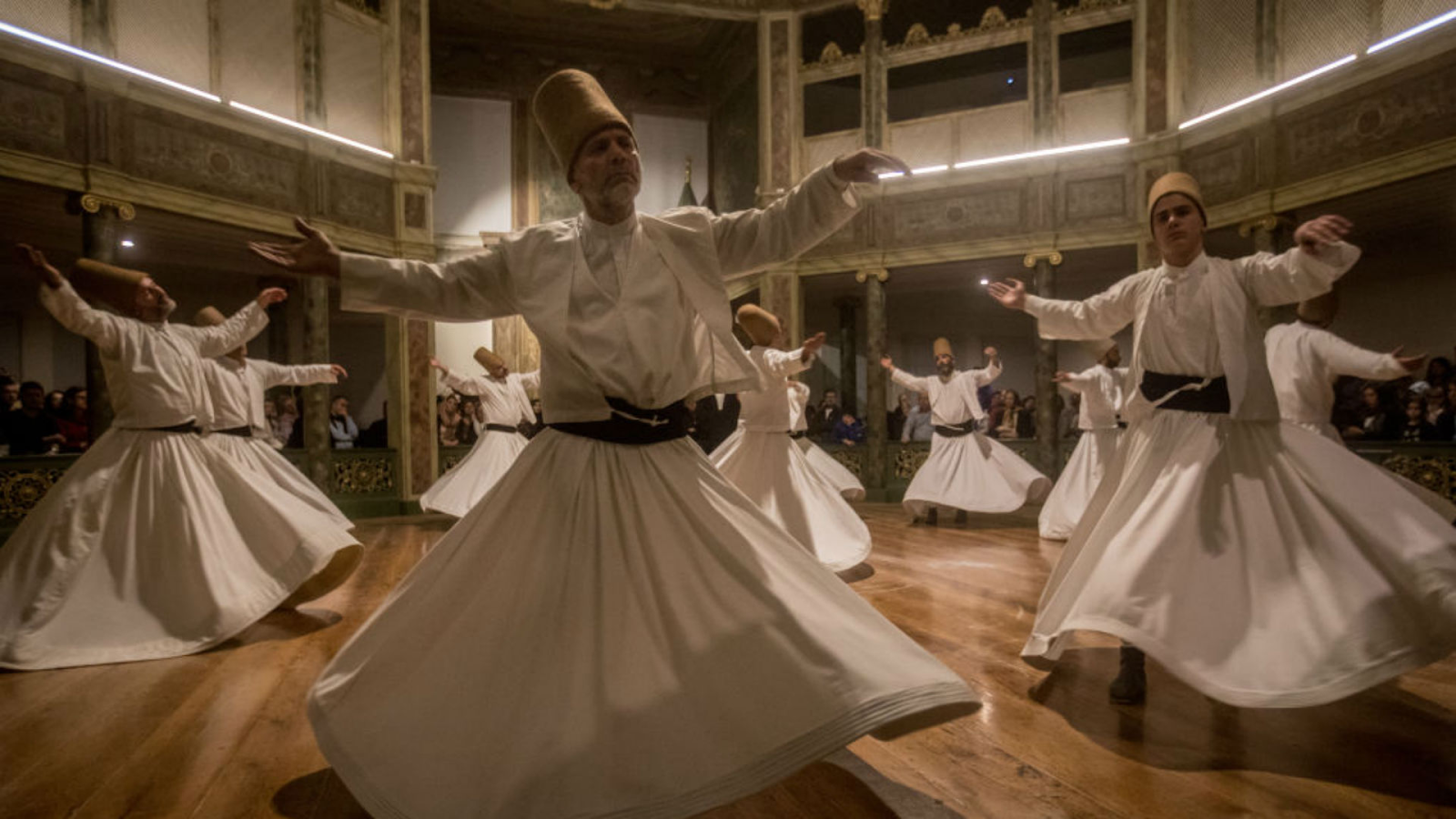
Some Sufi orders use devotional music and ritual movements, akin to dance, to further enhance the experiential nearness to God they are seeking. This practice is most commonly associated today with the Mevlevi Sufi order’s Dervishes of Turkey, often referred to as the ‘Whirling Dervishes.’

Identification with Sufism is highest in sub-Saharan Africa. In 11 of 15 countries surveyed in the region, a quarter or more Muslims say they belong to a Sufi order, including Senegal, where 92% say they belong to a brotherhood. In the other regions surveyed, affiliation with Sufi orders is less common.

Sufi leaders, communities, and sites have frequently been targeted by acts of violence perpetrated by extremist groups in different parts of the world. Pakistan has seen considerable violence aimed at Sufi targets, with dozens of shrines bombed and prominent Sufis attacked. In Egypt’s restive Sinai region, a deadly assault on a Sufi mosque in the town of Bir al-Abed in November 2017 saw over 300 people killed and at least a 120 injured. 

The Islamic State targets Sufis because it believes that only a fundamentalist form of Sunni Islam is valid. Some consider Sufis to be apostate, because saints were not part of the original practice of Islam at the time of the Prophet Muhammad.


References
https://www.nytimes.com/2017/11/24/world/middleeast/sufi-muslim-explainer.html
https://institute.global/policy/what-sufism
https://www.pewresearch.org/religion/2012/08/09/the-worlds-muslims-unity-and-diversity-1-religious-affiliation/

Thursday, April 7, 2022

Prayer Warrior

I heard this term for the first time when I watched a movie titled 90 minutes in heaven. Googling this term I learn a bit more about this curious term. Prayer warrior is a term used by many evangelical and other Christians to refer to anyone who is committed to praying for others. Prayer warriors see themselves as engaged in spiritual warfare against satanic forces. They are convinced that their prayers can help prevent bad things from happening to people and usher good things into people’s lives. Jesus Christ leads two armies: the army of holy angels in heaven and the army of prayer warriors on Earth. Jesus has given you the authority to pray in His name and to know that He will answer your prayers according to God’s will and at the right time. Be confident that you can pray to usher God’s power into any situation. The prayer warriors share a few similar traits: Worshipful, God-centered, Empathetic, Persevering and Loving.


Interesting that science has done some research the efficacy of prayer in faith healing. The results are contradictory.  Empirical research indicates that prayer and intercessory prayer have no discernible effects. While some religious groups argue that the power of prayer is obvious, others question whether it is possible to measure its effect. Basic philosophical questions bear upon the question of the efficacy of prayer – for example, whether statistical inference and falsifiability are sufficient to "prove" or to "disprove" anything, and whether the topic is even within the realm of science. 

From religious point of view the faithful cannot allow themselves to dismiss prayer from their lives simply because it might not seem to have pragmatic value. Whether or not prayer works, the faithful must engage in it, simply because God Himself commands us to do it.  It is inescapable that prayer is an expected activity for the people of God. Furthermore, Jesus the supreme model in all things, clearly made prayer a huge priority in His life. We can do no less.

Looks like prayer is not within the realm of science.


Saturday, February 26, 2022

lost and found

I read two different news about lost and found on BBC about 5 days ago. I had no idea if BBC put these two news  on purpose but they made me ponder about lost and found. The first news is about A dog that has been reunited with her owners in California after being missing for 12 years. The second one is about one criminal who got arrested after 12-year hunt


The dog was able to be identified when the animal services officer scanned the dog's microchip. The detail of her owner's contact details was available from the chip firm and she still had the same mobile number. The dog was found about 60 miles from where she had gone missing in 2010.

Police arrested the criminal after they were told he was thousands of kilometers away in Queensland the neighboring state of Victoria where the crime was committed. There had been several unconfirmed sightings of him across the country, but police had reached a dead end in their search in 2017. The criminal had experimented with changing his appearance and demeanor to evade detection, and he was discovered with items that could disguise him, such as hair dye.

Twelve years is a long time. In twelve years three American President would have been elected and left the white house, Australia would have moved 84 cm due north east, 3 world cups, etc. The first story tells me the power of IT. The chip lasted so many years presumably in rather rough condition. The dog would likely be living on its own and there is no telling what kind of life it was. The second one tells me that Australia is pretty vast and rather empty. A fugitive could escape the surveillance despite Police chasing him around (A reward of A$100,000 had been offered for information leading to his arrest). It also be due to people's tendency to mind their own business. In any case the criminal did his part by having items that could disguise him.

I guess this world is getting smaller by the presence of IT and internet. In the future I guess finding things, persons, etc. would be more and more easier so that some gives advice how to disappear from the Internet. Well, we could be lost from the Internet but as part of society we would still be recorded elsewhere, we have ID, bank account, school records etc. which all are available to authorities. 

We would never be nobody


Wednesday, February 16, 2022

Is hell empty ?

A friend sent me a resume of a presentation titled the afterlife: heaven, hell and purgatory. There Hans Urs Von Balthasar was mentioned. A quick googling informed me that he was famous (or infamous) for suggesting that Hell might be empty.  Dare We Hope That All Men Be Saved? he asked. Logically all loving, all saving Father would not left any soul left in Hell. This would hard to digest if we thought that all psychopath leaders like Hitler would eventually enjoy the same heaven as those who lost their life in Auschwitz tortured under his cruel command.

I guess the decision to send some souls to hell would be God's prerogative but faithful might ask about God's justice.  After all we would like to know how are we going to please Him as faithful. Random acting God would be hard to follow/obey as we would be clueless.

Some would argue that despite the romantic thinking of Balthasar hell is real and not empty even though despite Church declaring saints (confirmed to be in heaven) there is such thing as anti-saints (confirmed to be in hell)

I thought half of my heart would want God to be merciful that hell would be abolished but at the same time I believe we still need to have some guidance on the implication of being unjust to other human beings. If death is definitive and there is no alter life then the hope a just universe is empty as those evils human beings would escape the punishments as there is nothing left in the other side of death.

Of course all these would still be speculation. There is no way to empirically test any hypothesis. All we have is theology and I would suspect that theology is more or less affected by our understanding of ourselves, human beings. God that is completely outside our  experiences as human beings would be unthinkable. 


Thursday, September 3, 2009

blurr

Kalau benar bahwa kitab suci itu sungguh ditulis dua kali : yang pertama tidak menggunakan abjad apapun - karena ia berupa alam semesta raya (yang kedua : kita sudah tahu semua, berupa buku dari jaman kuna yang memuat cerita Allah yang personal). Apakah ke-2 kitab suci ini bicara hal yang sama ? Apakah dari alam kita bisa menemukan Tuhan personal? Tuhan yang cemburu, yang marah dan yang mengasihi ? yang menggugat dosa dan menjawab doa.

Tuhan personal terutama kita jumpai dalam agama samawi (judaisme, kristiantias dan islam). Agama-2 ini meyakini bahwa ada kalanya dimasa lampau Tuhan "berbicara" dengan manusia. Paling tidak begitulah kita baca dalam kitab suci. Apakah mungkin ini cuma simbolisme belaka ? Bukan wewenang saya untuk menjawab - tetapi sebentar kita amini saja bahwa - somehow - begitulah yang terjadi - bahwa Allah berinteraksi secara eksplisit dengan manusia. Eksplisit dalam arti - tidak diragukan bahwa yang diseberang sana itu (kalau dianalogikan manusia sedang bicara lewat telpon) adalah Allah dan bukan pihak lain.

Saya tidak pernah tidak bicara dengan manusia sehingga belum dapat saya bayangkan bagaimana kalau saya dapat berwawancara dengan makhluk lain (apalagi Tuhan). Tetapi untuk melanjutkan diskursus kali mari telaah obrolan dengan sesama manusia tetapi dari lain budaya. Yang kerap terjadi kiranya adalah terutama dua hal prasangka dan "lost in translation". Prasangka karena : saya tidak paham persis sistem makna kawan bicara - apakah bicara keras itu sopan ? atau harus bicara lembut-2 saja ? Bagaimana saya menerka sistem makna lawan bicara kalau saya belum pernah berjumpa sebelumnya dengan yang serupa dengan dia ? Hal lain adalah : lost in translation. Segenap naskah terjemahan boleh dibilang macam penghianatan pada teks asli. Apa boleh buat - setiap bahasa punya cara khas untuk mendeskripsikan sebuah gejala. Misal : Nasi, beras dan padi adalah rice. Maka untuk menterjemahkan "rice" perlu dilihat konteks dan konteks adalah sistem makna yang juga tidak semudah membalik tangan untuk memahaminya

Lalu bagaimana kasus pembicaraan dengan Tuhan ? Sudah tentu agama-agama mendaku (to claim) bahwa hal ini sungguh terjadi dan tidak hendak saya debat iman mereka. Hanya saja ini sungguh merupakan lompatan yang luar biasa. Sama sekali tidak intuitif. Dari alam paling-paling kita bisa sampai pada pemahaman macam: bagaimana manusia ini kecil, bahwa keteraturan alam sungguh menakjubkan, dsb - tetapi dari titik itu ke pemahaman akan Tuhan personal adalah -lagi-lagi- a leap of faith.

Baik kita kembali ke pertanyaan semula: dari alam, apakah kita bisa menemukan Tuhan personal? Kira saya - saya akan menjawab - tidak. Karena saat kita memaknai sesuatu kita berangkat dari sistem makna kita. Sistem makna kita adalah kaca mata kita - sebuah benda menjadi hijau jika ia hijau tetapi juga kalau kaca mata kita hijau. Dan jika kaca mata kita lekat dilensa mata maka kita tidak tahu lagi apa ia sungguh hijau atau karena mata kita diset untuk melihat segala sesuatu sebagai hijau

Interpretasi akan alam pun bisa macam-macam, tergantung kaca mata kita. Alam bisa dipahami sebagai materi dan energi - dan tidak lebih dari itu. Atau ia diber persona (dewa hujan, dsb). Mana yang benar ? Tidak bisa dijawab dengan mudah kecuali disepakati dulu asumsi-asumsi yang kadang tersembunyi.

Maka Galileo dan Darwin menjadi skandal manakala mereka dikatakan mencampakan manusia dan bumi dari tempat terhormat (pusat semesta dan citra Allah) ketempat banal (bagian renik semesta dan hasil evolusi buta). Tetapi mereka sebenarnya cuma menunjukan interpretasi lain dari kenyataan yang sama.

Mungkin orang beragama tidak suka jika agamanya dikatakan sebagai interpretasi semata. Agama saya tentu yang paling benar! Tetapi tidak boleh mereka lupakan adalah - apakah saya tahu saya bisa menemukan kebenaran ? Tidakkah mungkin bahwa yang terjadi adalah saya meneguhkan interpretasi saya dengan melulu melihat segala sesuatu dengan kaca mata saya. Lain kaca mata adalah tidak mungkin.Dan karena hanya mungkin ada satu kacamata yang benar - kita berkelahi demi interpretasi. Ironis.